Friday, 18 November 2022

Why do the English dress so badly?


I was thinking about this in the queue to see the Queen. (I never actually met her whilst she was alive, so somehow joining the great unwashed to pay my respects to her in death became just that little bit more important.)

One answer must of course be "fashion", though there's a sense in which the English follow a sort of anti-fashion. Apart from maybe haircuts and brand labels, it will be interesting to see how the screen dramatists of the future try to evoke the style (or lack of it) of today in "period" settings.

Because the truth is that there's something altogether timeless about the ahistoricity of today's lack of fashion. The same old mixture of shabbiness and garishness, whose only constant feature is its failure to please the eye, could be of any decade from the 1990s to the 2020s - an entire generation effectively devoid of elegance or style.

One is tempted then to blame "consumerism" - at least in the sense of Edward Bernays and all his brain-washing ad campaigns. Self-expression trumps good taste, and so the only thing they all have in common is that they dress badly. "You can't tell me what to wear. I'll wear what I like." And once the very idea that there is such as thing as dressing nicely has disappeared, all that's left is dressing horribly. (One can't help ponder that this is the sort of explanation that would appeal to the likes of Adam Curtis - and even the King himself.) 

But above and beyond there's something more to it than that. The English now have precious little sense of dressing for an occasion. They no longer dress appropriately for town or country, for weekdays or Sundays, for work, for leisure, or for pleasure, let alone for times of national mourning. In fact of course Sundays and workdays have changed places in people's priorities, since everyone started working in offices rather than in real jobs (and stopped going to church on the sabbath). One dreads to think what the new culture of "working from home" will produce. Will the next royal lying in state see people queuing up in their Jim Jamz?

So if the new King really is set on restoring "harmony" - to the planet, to the realm, to the lives of his people! - encouraging men to dress nicely would been an obvious place to start.

UPDATE: Paul Joseph Watson adds his comments here. "People dress badly because they don't like themselves." Well, there's certainly something to that.

Thursday, 17 November 2022

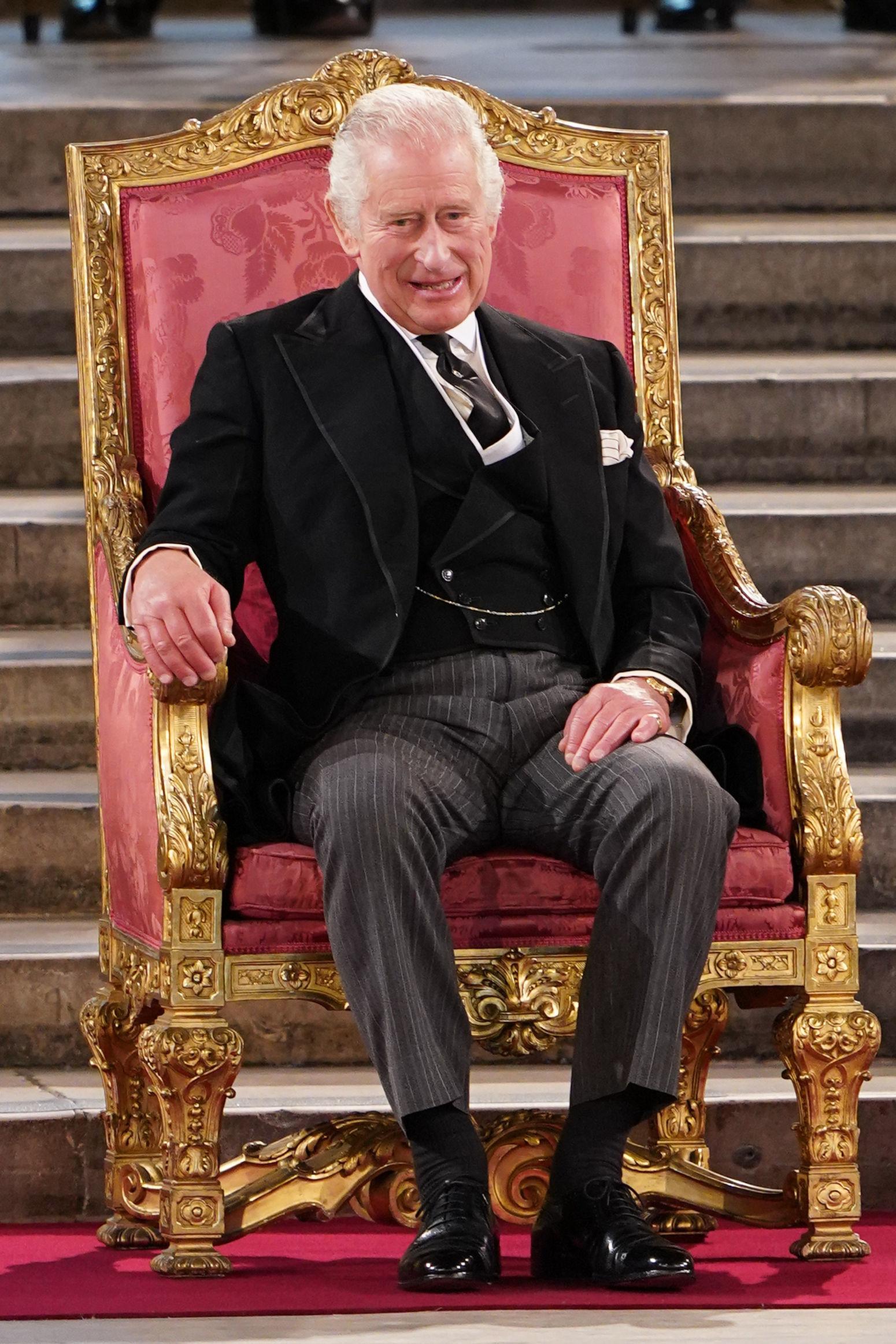
Is the King of England a traditionalist?

Well, Yes and No!

Certainly he thinks of himself as a traditionalist - or at any rate trad-adjacent. And he certainly self-identifies as firmly anti-"modernist".

The problem though is that if you dig a little deeper he does indeed have some very odd ideas about what modernism actually is. Yes, it's something artificial - perhaps even "rationalist" (and, at that, not necessarily particularly rational). But what is the fundamental principle of the idea? What is the source of its power?

For what it's worth, I don't think he really understands Modernism, and that's because he doesn't realise quite how deep, dark and dangerous its roots really are. And thus his "traditionalism" isn't so much anti-Modernist as simple mystical perennialism.

And that, though it may be esoteric in and of itself, is hardly a secret. As Prince of Wales, the King was a patron of The Temenos Academy, and for a time he quite literally hosted it in the headquarter of his architecture institute (which is now The Prince's Foundation).

The connexion between the King's perennialist "traditionalism" and religious traditionalism in fact comes via people like Rama P Coomaraswamy, who was one of the first generation of Catholic trads to oppose "the changes" that followed Vatican II - and who was of course the son of Ananda K Coomaraswamy, at least one of whose works is available on the Temenos Academy's website.

All of which makes it particularly disappointing that the King's own understanding of revelation is, to put it bluntly, orthodoxly Modernist.

Revelation is not deemed possible from an empirical point of view. It comes about when a person practises great humility and achieves a mastery over the ego so that ‘the knower and the known’ effectively become one. And from this union flows an understanding of ‘the mind of God’. 
[The Prince of Wales, Harmony - A New Way of Looking at Our World, p. 13]

Because this is more or less exactly point 20 (i.e. condemned proposition) in Pope Pius X's Syllabus Condemning the Errors of the Modernists:
Revelation could be nothing else than the consciousness man acquired of his revelation to God. 
[Lamentabili Sane]
My feeling, for what it's worth, is that the new King is a very nice man. But unfortunately his "traditionalism" without an actual belief in the Revelation of Jesus Christ, in person, in our human nature, on earth, via his hypostatic union with the Father, to the Apostles, and thence to His Church by word and by scripture, is not going to count for much more than a vaguely fogeyish, Scrutonian (or even Hitchensite) "small-c conservatism".

The Lost Tories

No, obviously it's not "left-wing" judges . Nor is it even the "left-wing" Establishment . I mean, obviously both th...